The street
Clifton Hill, then and now
How a ferry road above the Niagara gorge became Clifton Hill, the street of arcades, wax museums and the SkyWheel that sits beside the magic theatre.
Book the magic show ↗Quick answer
Clifton Hill began as Ferry Road, the way down to the rowboats that crossed the Niagara River before the suspension bridge. A British officer laid out a settlement here in the 1830s and named it Clifton. Hotels, estates and fires followed, and from the 1920s the street turned to tourism. Today it runs from the Niagara Parkway up to Victoria Avenue, packed with attractions.
Ferry Road
Before it was Clifton Hill, Wikipedia says, the street was Ferry Road, named for the rowboat service that carried people across the Niagara River between Canada and the United States until the Niagara Falls Suspension Bridge was completed. The road gave access to the Niagara Gorge, where the boats docked. The land had been granted to the Bender family in 1782 as part of a United Empire Loyalist land grant.
Captain Creighton's Clifton
In 1832, according to Wikipedia, the property was bought by Captain Ogden Creighton, a half-pay British Army officer, who laid out streets and building lots and named the future settlement Clifton, presumably after Clifton on the gorge of the River Avon in Bristol. His house, Clifton Cottage, stood on a high bank facing the American Falls. During the troubles that followed the Rebellion of 1837, it became headquarters for a military detachment guarding the border ferry.
Hotels, estates and fires
The first Clifton Hotel was built at the base of the street in 1833. In 1842 the financier Samuel Zimmerman began a large estate called Clifton Place along the south side of the road, but he died in a railway accident in 1857 before his mansion was finished. Wikipedia says only a fountain from the estate survives, at the northern end of Queen Victoria Park. The Clifton Hotel burned in 1898, was rebuilt, and burned again at the end of 1932, after which the land was deeded to the Niagara Parks Commission for the Oakes Garden Theatre.
The turn to tourism
Wikipedia dates the street's growth as a tourist destination to the 1920s, with inns, tourist camps and campgrounds opening along it. From the 1960s museums arrived: the Houdini Hall of Fame, Ripley's Believe It or Not!, Louis Tussaud's Waxworks, the House of Frankenstein and the Guinness World Records museum among them. The Houdini museum's connection to magic did not last; a fire destroyed it in 1995, as a separate guide on stage magic explains.
Clifton Hill today
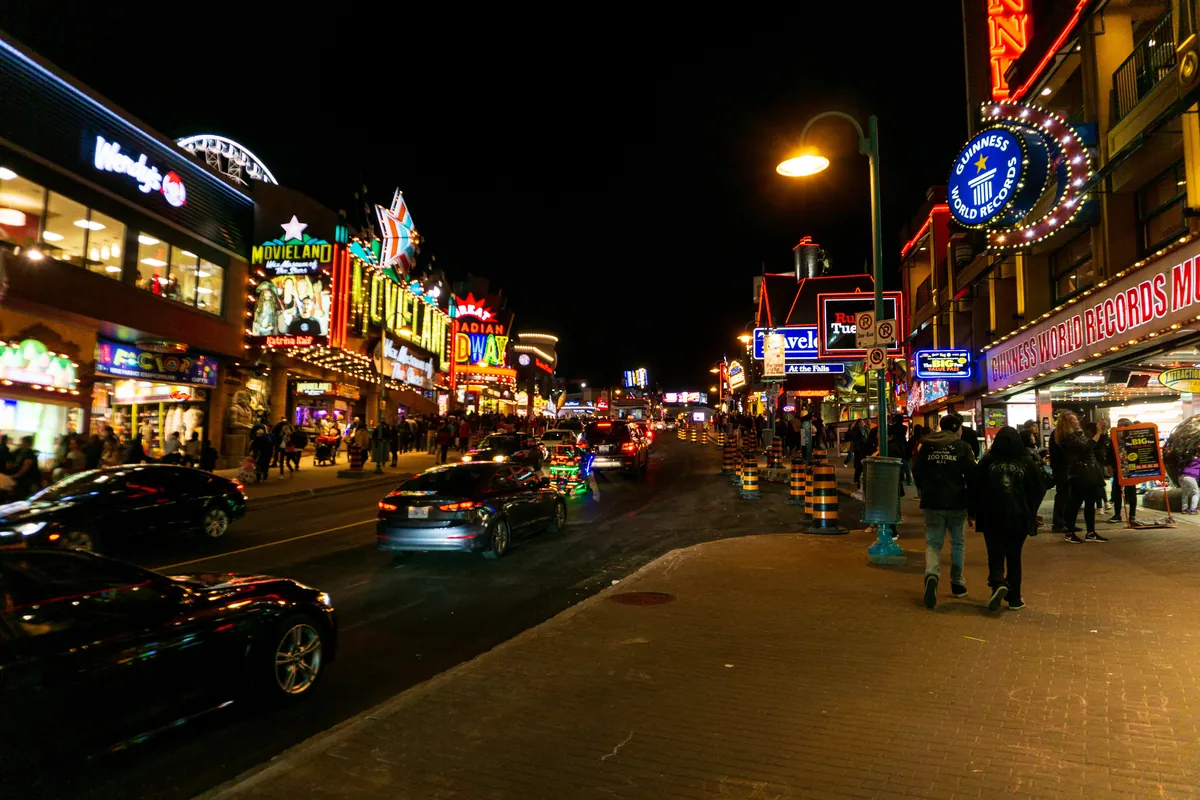
Wikipedia now describes Clifton Hill as one of the major tourist areas of Niagara Falls, Ontario, and a major amusement area and centre for night life. The street leads from River Road on the Niagara Parkway to Victoria Avenue, close to the falls and the river, and it is lined with gift shops, wax museums, haunted houses, video arcades, restaurants, hotels and themed rides. Properties are bought, sold and renamed often, so the line-up of attractions shifts from year to year.
The SkyWheel
The tallest thing on the street is the Niagara SkyWheel, which Wikipedia puts at 53.3 metres (175 feet) and places in the middle of Clifton Hill. It opened on 17 June 2006 with 42 fully enclosed cars, heated in winter and air-conditioned in summer, and it runs all year. A ride of around ten minutes gives views over the Niagara River and both falls. A separate guide on this site compares it with the magic show for families planning an evening.
Read next: Magic show or the SkyWheel?
Where the magic show fits
The theatre that stages Niagara Magic Live stands on Ellen Avenue, near Clifton Hill rather than on it, which makes the street the obvious place for the hour before or after the show. Walk down towards River Road and the falls, and you pass most of what Wikipedia lists, from the wax museums to the arcades. Cameras are not allowed in the theatre, so Clifton Hill's neon is where most visitors take their evening photographs.
Sources